We Use CookiesWe use cookies to enhance the security, performance, functionality and for analytical and promotional activities. By continuing to browse this site you are agreeing to our privacy policy

10 Best Nas Devices 2026 in the United States
How do we rank products for you?

Our technology thoroughly searches through the online shopping world, reviewing hundreds of sites. We then process and analyze this information, updating in real-time to bring you the latest top-rated products. This way, you always get the best and most current options available.

headphones-stars

Our Top Picks

#1

Winner

Synology DS1522+ 5-Bay DiskStation NAS (AMD Ryzen R1600 8GB Ram 4xRJ-45 1GbE LAN-Port) 5-Bay 20TB Bundle with 5x 4TB Seagate IronWolf

Rating
10.0
Chosen by1,217
Software and Features

Most important from
51 reviews

Software and Features
Delivers solid, impressive performance with a rich set of features ideal for backing up servers, workstations, and cloud services.

The Synology DS1522+ is a solid choice for anyone needing a mid-sized NAS device with good flexibility. It comes with 5 bays, allowing you to install multiple hard drives, and the included bundle offers 20TB total storage using five 4TB Seagate IronWolf drives, which are designed for reliable NAS use. Powered by an AMD Ryzen R1600 processor and 8GB of RAM, this NAS can handle more demanding tasks and support several users accessing files at the same time without slowing down. It supports RAID configurations, which means you can protect your data by spreading it across drives in ways that keep it safe if one drive fails.

Connectivity is strong with four Gigabit Ethernet ports (RJ-45 1GbE), providing fast and stable network access, which is important if multiple devices are connected or if you’re moving large files. Synology’s software enhances the experience by offering private cloud features, letting you sync and access your data remotely with ease, while also including built-in security measures to keep your files safe. The device’s metal build gives it a sturdy feel, though it weighs around 15.7 pounds, which is normal for this type of equipment.

One minor point is the 5400 RPM hard drives, which are quieter and cooler but not as fast as 7200 RPM models, so transfer speeds might be slightly slower for very heavy workloads. This NAS is best suited for small to medium businesses or tech-savvy home users who want a dependable, expandable storage solution with strong data protection and remote access features.

Rating
10.0
Chosen by1,217
Software and Features

Most important from
51 reviews

Software and Features
Delivers solid, impressive performance with a rich set of features ideal for backing up servers, workstations, and cloud services.
#2

BUFFALO TeraStation 5820DN 8-Bay Business Desktop NAS 80TB (4x20TB) with Hard Drives Included RAID iSCSI Network Storage File Server

Rating
8.8
Number of Bays
Software and Features

Most important from
3 reviews

Number of Bays
Extra drive bays offer ample room for future storage expansion without needing to replace the device.
Software and Features
The inclusion of a free backup software license adds value and ease to the data protection process.

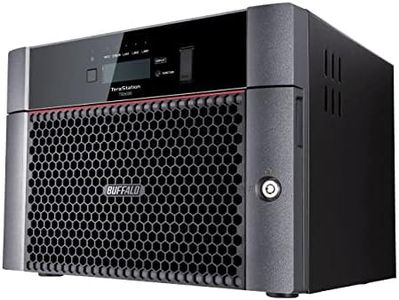
The BUFFALO TeraStation 5820DN is a strong choice for businesses needing reliable, large-scale data storage. It comes with 8 bays and 4 pre-installed 20TB hard drives, offering a total of 80TB raw space. With RAID 5 configured by default, you get around 54TB usable storage that balances speed and protection, and you can switch to RAID 6 for even better redundancy or RAID 0 for maximum capacity without protection. The device includes built-in 256-bit encryption and two-factor authentication, making it a secure option for sensitive data. It supports snapshot backups that help you recover files quickly without interrupting work, which is handy against ransomware threats.

Connectivity is excellent with a native 10GbE port, meaning fast data transfers without needing extra hardware upgrades. The NAS is compatible with Windows, Mac, and Linux, and integrates with popular cloud services like Dropbox and Microsoft Azure for added backup flexibility. It runs on a stable, business-focused system designed to handle heavy workloads smoothly. The device is relatively large and weighs nearly 24 pounds, so it’s best suited for a fixed office setup rather than portable use.

This NAS is ideal for medium to large businesses needing secure, high-capacity storage with fast network access and robust backup options. It includes a solid 3-year warranty with optional extensions and 24/7 support, providing added peace of mind.

Rating
8.8
Number of Bays
Software and Features

Most important from
3 reviews

Number of Bays
Extra drive bays offer ample room for future storage expansion without needing to replace the device.
Software and Features
The inclusion of a free backup software license adds value and ease to the data protection process.
#3

Asustor Lockerstor 10 AS6510T - 10 Bay NAS, 2.1GHz Quad-Core, 2 M.2 NVMe SSD Slot, 10GbE Port, 2.5GbE Port, 8GB RAM DDR4, Enterprise Network Attached Storage (Diskless)

Rating
8.5
Storage Capacity
Processor and RAM
Connectivity

Most important from
685 reviews

Storage Capacity
The device is a powerful solution for expanding storage and enhancing backup strategies, especially when integrated with existing NAS setups.
Processor and RAM
Advanced features deliver strong performance for demanding workloads, ideal for business or power users managing large data volumes.
Connectivity
Dual 2.5GbE and 10GbE ports provide high-speed networking potential, though actual performance depends on the user's network infrastructure.
Software and Features
Setup is straightforward and user-friendly, making it easy to get started quickly.

The Asustor Lockerstor 10 AS6510T is a strong choice for users who need a high-capacity NAS with 10 drive bays, allowing up to 180TB of storage using SATA SSDs or HDDs. Its Intel Atom quad-core 2.1 GHz processor combined with 8GB DDR4 RAM (expandable to 64GB) offers solid performance for demanding tasks, making it suitable for small businesses or power users who manage large amounts of data. The inclusion of two M.2 NVMe SSD slots helps boost speed by providing fast cache options, which can significantly improve responsiveness.

Connectivity is a highlight, with dual 10GbE and 2.5GbE ports enabling very fast network speeds—up to 20 Gbps on the 10GbE ports or 5 Gbps on the 2.5GbE ports—ideal if you have a compatible high-speed network setup. This makes file transfers and streaming smoother, especially in a multi-user environment. The device supports RAID configurations, which help protect your data by spreading it across drives or creating backups.

Made from metal, it has a sturdy build and a compact footprint for a 10-bay NAS. The 3-year warranty adds peace of mind. However, the device is diskless, so you’ll need to purchase hard drives separately, which adds to the initial cost. Given its hardware, power consumption might be higher than smaller NAS models, which is worth considering if energy use is a priority. This NAS fits users who require large storage capacity, fast network connections, and strong performance for business or heavy personal use. It offers speed, expandability, and reliability for those needs.

Rating
8.5
Storage Capacity
Processor and RAM
Connectivity

Most important from
685 reviews

Storage Capacity
The device is a powerful solution for expanding storage and enhancing backup strategies, especially when integrated with existing NAS setups.
Processor and RAM
Advanced features deliver strong performance for demanding workloads, ideal for business or power users managing large data volumes.
Connectivity
Dual 2.5GbE and 10GbE ports provide high-speed networking potential, though actual performance depends on the user's network infrastructure.
Software and Features
Setup is straightforward and user-friendly, making it easy to get started quickly.

Buying Guide for the Best Nas Devices

When choosing a NAS (Network Attached Storage) device, it's important to consider your specific needs and how you plan to use the device. NAS devices are used for storing and sharing data across a network, making them ideal for both personal and business use. They can serve as a central hub for your files, backups, and media, accessible from multiple devices. To make an informed decision, you should understand the key specifications and how they align with your requirements.
Storage CapacityStorage capacity refers to the total amount of data that the NAS device can hold. This is important because it determines how much data you can store and share. Storage capacity is usually measured in terabytes (TB). If you have a large amount of data, such as high-resolution videos or extensive backups, you will need a NAS with higher storage capacity. For personal use, 2-4 TB might be sufficient, while small businesses might need 8-16 TB or more. Consider your current data needs and future growth when choosing the storage capacity.
Number of BaysThe number of bays in a NAS device indicates how many hard drives it can accommodate. This is important because it affects the total storage capacity and the ability to configure RAID (Redundant Array of Independent Disks) for data redundancy and performance. NAS devices typically come with 1 to 8 bays. For basic home use, a 1-2 bay NAS might be enough. For more advanced users or small businesses, a 4-8 bay NAS allows for greater storage capacity and more RAID options. Choose the number of bays based on your storage needs and desired level of data protection.
Processor and RAMThe processor and RAM in a NAS device determine its performance and ability to handle multiple tasks simultaneously. A more powerful processor and higher RAM are important for tasks such as media streaming, running applications, and handling multiple users. Entry-level NAS devices may have a basic processor and 1-2 GB of RAM, suitable for simple file storage and sharing. For more demanding tasks, look for a NAS with a multi-core processor and 4-8 GB of RAM or more. Consider the types of tasks you will be performing and the number of users accessing the NAS when choosing the processor and RAM.
RAID SupportRAID (Redundant Array of Independent Disks) is a technology that combines multiple hard drives into a single unit to improve performance and provide data redundancy. RAID support is important for data protection and reliability. Common RAID levels include RAID 0 (striping), RAID 1 (mirroring), RAID 5 (striping with parity), and RAID 6 (double parity). For personal use, RAID 1 or RAID 5 might be sufficient to protect against data loss. For business use, RAID 5 or RAID 6 offers better data protection and performance. Choose a NAS with RAID support that matches your need for data redundancy and performance.
ConnectivityConnectivity options on a NAS device determine how it can be accessed and integrated into your network. Important connectivity features include Ethernet ports, USB ports, and sometimes Wi-Fi. Ethernet ports are essential for connecting the NAS to your network, with Gigabit Ethernet being the standard for fast data transfer. USB ports allow for connecting external drives and other peripherals. Some NAS devices also offer Wi-Fi connectivity for wireless access. Consider your network setup and how you plan to access the NAS when evaluating connectivity options.
Software and FeaturesThe software and features provided by a NAS device can greatly enhance its functionality. This includes the operating system, user interface, and additional applications for tasks such as media streaming, file synchronization, and backup. A user-friendly interface and robust software ecosystem are important for ease of use and maximizing the NAS's capabilities. Look for features such as remote access, mobile apps, and integration with cloud services. Consider what additional features you need and how they will benefit your use case when choosing a NAS device.
Power ConsumptionPower consumption refers to the amount of electricity the NAS device uses. This is important for both cost and environmental considerations, especially if the NAS will be running 24/7. NAS devices with more powerful processors and multiple hard drives typically consume more power. Look for energy-efficient models that offer features such as scheduled power on/off and hard drive hibernation. Consider the power consumption in relation to your usage patterns and the potential impact on your electricity bill.

FAQ

Most Popular Categories Right Now